Showing posts with label Buddhist. Show all posts

Saturday, June 25, 2011

I am with DAP and proud to be one

Hmm..... maybe those who reads only English paper like The Star and have yet to attend any of the last two DAP fundraising dinners in USJ are not aware of the fact that I has been involved with  DAP for more than a year now. I am a DAP member and proud to be one too.

Since there is free publicity for my branch now, if anyone wanna join our new branch - the DAP USJ East branch, you are welcome to contact me.

And as usual, being a Buddhist activist for more than 20 years now,  if the Buddhist temples/centres you are attached to have any issues to raise especially with the Selangor state government, do continue to contact me too.- Loka SK Ng


From the Star
Saturday June 25, 2011


‘We’re PKR and DAP members’


By EDWARD R. HENRY


edward@thestar.com.my


PETALING JAYA: Two Subang Jaya municipal councillors have admitted that they were appointed under the non-governmental organisation (NGO) quota although they were members of PKR and DAP.


Jaberi Ami, the Kota Raja PKR member and Angkatan Muda Keadilan treasurer and Loka Ng Sai Kai, a USJ DAP branch member also admitted that their political affiliation helped them to get things done.

 
Jaberi said it was important to be in a political party to fully understand policies of the state. He added that being in a political party could help in his public service.


“I have been a PKR member since 2008. I have also been with the Muslim Factory Workers Welfare Association, an NGO, for more than five years.


“I see no problem with my political membership. I have an unwavering spirit to fight for the workers' welfare. So, I put forward to the state views on workers' welfare,” he said.

 
Ng felt it was important to be committed with the state's policies and “there is nothing wrong in being a party member.”

He has been active in Buddhist organisations for close to 20 years. He has also been Malaysian Youth Council vice-president.


Ng said he joined DAP about 18 months ago and found his membership beneficial in resolving many issues.


“I am committed to the state government's policies, but at the same time I am very firm and independent of state government control, I have no problem voicing out issues affecting the rakyat,” he said.


Both councillors were commenting on The Star's front-page story yesterday which highlighted that only 10 municipal councillors in Selangor were Independents and represented NGOs, compared to the state government's claim of 71.

Coalition of Non-Governmental Organi-sations and Professional Appointed Councillors (Conpac) chairman Tan Jo Hann said he was thankful for grassroots leaders such as Ng and Jabri. “But I am questioning what the Pakatan government had agreed to do. It is a matter of principle.

“Conpac wants 25% of municipal councillors to be full-fledged NGO representatives.”


Tan added that he was not undermining the skills or commitment of the councillors but just wanted state executive councillor Ronnie Liu to honour the 25% quota agreement for NGO representatives.


Saturday, June 11, 2011

Selangor Menteri Besar during Selangor State Level Wesak Celebration

Ucapan

YAB TAN SRI DATO’ SERI ABDUL KHALID BIN IBRAHIM

DATO’ MENTERI BESAR SELANGOR

Pada

MAJLIS SAMBUTAN HARI WESAK NEGERI SELANGOR

Tarikh  5 JUN 2011 (AHAD)  3 REJAB 1432
Tempat AUDITORIUM DEWAN JUBLI PERAK, BANGUNAN SSAAS, SHAH ALAM

Masa 8.15 MALAM


Selamat Sejahtera dan Selamat Menyambut Hari Wesak kepada semua Penganut Agama Buddha.
Yang Berhormat Dato’ Teng Chang Khim,
Tuan Speaker Dewan Negeri Selangor;
Yang Berhormat Ahli-Ahli Majlis Mesyuarat Kerajaan Negeri Selangor;
Yang Berhormat Ahli-Ahli Dewan Undangan Negeri dan Ahli-Ahli Parlimen;
Yang Berbahagia Ketua-Ketua Jabatan dan Warga Kerja Awam dan Swasta;
Yang Berusaha Encik Loka Ng Sai Kai,
Pengerusi Selangor Buddhist Development Committee;
Yang Berbahagia Dato’-Dato’, Datin-Datin, Ahli-Ahli Majlis, Para Pemimpin Pertubuhan Agama dan Para Pemimpin Masyarakat;
serta Wakil-Wakil Media Massa, Tuan-Tuan dan Puan-Puan yang Budiman.

(1) Saya bersyukur kerana dapat hadir bersama tuan-tuan dan puan-puan pada malam ini khususnya kepada para penganut agama Buddha yang menyambut hari Wesak pada tahun ini. Saya berbangga kerana pihak Kerajaan Negeri yang mengusahakan sambutan hari Wesak peringkat negeri pada kali ini, sementelahan pula penduduk Selangor yang beragama Buddha merupakan golongan beragama kedua besar di negeri ini selepas golongan penduduk beragama Islam.

Para Hadirin yang Dihormati;

(2) Kita maklum, Hari Wesak dirayakan oleh semua penganut agama Buddha di seluruh dunia. Ia dirayakan pada Mei setiap tahun, pada waktu bulan purnama, untuk memperingati tiga peristiwa penting, iaitu saat kelahiran Siddharta Buddha, saat beliau menjadi Buddha dan saat kemangkatannya. Perayaan bermula pada waktu pagi dengan penganut ajaran Buddha mengunjungi kuil Buddha untuk memberikan penghormatan kepada Buddha, yang dilambangkan oleh simbol-simbol Buddha seperti pagoda, patung Buddha dan pokok bodhi.

(3) Saya difahamkan Sambutan hari Wesak tahun ini lebih signifikan kerana ia merupakan ulang tahun ke- 2,600 para penganut agama Buddha menyambut saat pencerahan (enlightenment) penuh Buddha. Perkara yang boleh dijadikan iktibar adalah ciri-ciri kesederhanaan dan keharmonian dalam kehidupan manusia yang diberi penekanan oleh ajaran agama Buddha. Saya berpendapat ciri-ciri kesederhanaan dan keharmonian, yang juga wujud dalam ajaran agama-agama utama lain di dunia, wajar didekati dan diamalkan demi kesejahteraan semua.

(4) Saya menyarankan agar kita menjauhi dan menyingkir amalan ekstremis yang dipelopori oleh golongan tertentu yang tidak bertanggungjawab. Perbuatan mereka ini boleh menimbulkan suasana hasad dengki dalam kalangan masyarakat kita yang ingin hidup berbudaya tinggi dan beradab serta saling menyayangi antara satu sama lain; tidak kira kaum, bahasa mahupun agama.

(5) Sesungguhnya, budaya memupuk perasaan kasih-sayang dan hormat-menghormati antara satu sama lain harus dipertingkatkan dalam kehidupan harian agar masyarakat kita boleh bersama-sama bergerak menuju pembangunan negeri Selangor yang lebih mampan dan bestari.

Para Hadirin yang Berbahagia;

(6) Kerajaan Negeri Selangor memang sedar dan prihatin akan keperluan masyarakat beragama Buddha dan cabaran yang mereka hadapi. Saya difahamkan keperluan masyarakat beragama Buddha terutamanya terhadap tanah dan prasarana rumah ibadat meningkat secara mendadak sejak 30 tahun ini disebabkan peningkatan penganut dan anak-anak muda yang menyertai program keagamaan, pendidikan dan kebajikan.

(7) Baru-baru ini sempena perayaan hari Wesak saya sempat berkunjung ke rumah ibadat agama Buddha di Subang Jaya dan Shah Alam. Semasa di sana saya disambut mesra dan saya dapati dua-dua tempat tersebut penuh sesak dengan para penganut agama Buddha. Saya difahamkan keadaan yang sama juga wujud di tempat-tempat lain terutamanya di kawasan bandar yang mempunyai ramai penduduk beragama Buddha.

(8) Untuk pengetahuan umum, sejak Pakatan Rakyat menubuhkan kerajaan di negeri Selangor pada Mac 2008, kita lantas menubuhkan Jawatankuasa Hal Ehwal Selain Islam yang turut dihadiri oleh wakil-wakil daripada pertubuhan agama selain Islam termasuk tiga daripada agama Buddha. Jawatankuasa ini bermesyuarat enam kali setahun untuk mencuba menyelesaikan pelbagai isu yang berkaitan dengan pelbagai perkara seperti permohonan tanah dan pembinaan rumah ibadat selain Islam serta membincangkan isu kefahaman antara agama.

(9) Saya berharap, melalui penelitian Jawatankuasa ini, isu pemberian kelulusan lambat untuk pembinaan rumah ibadat agama Buddha yang memakan masa hampir 20 tahun sebagaimana yang pernah berlaku di Shah Alam semasa pentadbiran kerajaan terdahulu tidak berulang lagi.

(10) Kerajaan Negeri juga memberi bantuan kepada pelbagai pertubuhan agama untuk membaik pulih rumah-rumah ibadat dan menjalankan urusan keagamaan masyarakat selain Islam. Misalnya, pada tahun 2010, pihak Kerajaan Negeri memperuntukkan sebanyak RM3 juta untuk tujuan ini.

Para Hadirin yang Budiman;

(11) Bagi pihak Kerajaan Negeri, saya mengucapkan syabas kepada semua pemimpin dan penganut agama Buddha kerana segala peranan dan program yang dijayakan di negeri Selangor. Antara program kemasyarakatan yang dikendalikan termasuklah pembinaan insan dan pembangunan masyarakat, kebudayaan, program kitar semula dan bantuan bencana alam.

(12) Dalam hal ini, sangat wajar kiranya dapat pihak pertubuhan agama Buddha menjalin kerjasama dengan pihak Kerajaan Negeri dalam hal penyertaan sukarelawan untuk menghulurkan bantuan kepada mangsa malapetaka apabila diperlukan kelak.
(13) Di samping itu, rumah ibadat juga boleh dijadikan destinasi tarikan pelancong dari dalam dan luar negeri. Misalnya, pihak Kerajaan Negeri amat bangga terhadap usaha oleh rumah ibadat Fo Guang Shan Dongzen di Jenjarom yang berjaya menarik jutaan pelawat setiap tahun. Supaya lebih berkesan, saya cadangkan agar program perarakan kereta berhias hari Wesak sebagaimana yang diadakan di Petaling Jaya dan Seri Kembangan dimasukkan dalam takwim tahunan Tourism Selangor untuk menarik lebih ramai pelancong ke Selangor.

(14) Akhir kata, saya mengucapkan terima kasih kepada semua terutamanya para pegawai kerajaan Negeri dan pihak pertubuhan agama Buddha yang berganding bahu menjayakan program malam ini. Sekali lagi diucapkan, “Selamat Menyambut Hari Wesak”.

Terima kasih. Selamat sejahtera an Selamat malam.

Tuesday, June 7, 2011

Press Release on Selangor Wesak Celebration

Press Release by Mr. Loka Ng Sai Kai, Chairman of Selangor Buddhist Development Committee and Working Committee Chairman for the Majlis Sambutan Hari Wesak 2011 Peringkat Negeri Selangor in conjunction with the Majlis Sambutan Hari Wesak 2011 Peringkat Negeri Selangor organized by the Selangor State Government with the support of Buddhist organizations in Selangor.

Dated : 5th June 2011                   Time : 8:30pm

a. Buddhist community began to request for Wesak to be declared as a public holiday since 1926 when the then abbot of Mahindarama Buddhist Temple, Ven. K. Gunaratana make the proposal to the then colonial government.

b. During the Japanese occupation, a Japanese official in Dec 1944 urged the Penang Buddhist community to make representation to the Japanese government to declare Wesak in the coming year as a public holiday.

c. After World War II, the British government said it will only consider declaring Wesak as a public holiday if both the Mahayana and Theravada traditions can agree on a same date to celebrate Wesak day. A meeting on 1st March 1949 at Penang Buddhist Association agrees to celebrate Wesak Day on the full moon of May.

d. On 12th April 1949, the colonial government declares Wesak Day which falls on 12th May 1949 as a public holiday in Penang, Melaka, Kedah and Perak. Government servants who are Buddhists in Selangor, Kelantan, Perlis, Terengganu and Negeri Sembilan were given a holiday on Wesak Day.

e. After many years of efforts by Buddhist and political leaders, the Federation of Malaya government finally declares on 3rd Jan 1962 that the government had adopted the day of Wesak as a public holiday for the whole federation beginning from 1962.

f. The ability to make Wesak as a public holiday was a memorable event and great achievement in the annals of Buddhism in this country. It has united the Buddhist community to work for a common interest in seeking the government’s recognition of the community stature as the second largest religious group in the country.

g. For many years after 1962, the Buddhist community noticed that while the Prime Minister will regularly issue public congratulatory messages in-conjunction with important celebration of major religions in Malaysia, the Prime Minister’s message for Wesak Day was always conspicuously missing. It was only in 1999 after years of representation by the Buddhist community leaders that the then Prime Minister began issuing congratulatory message for Wesak Day.

h. In the 1990s, the government began organizing official state or national events for major religions in this country. But official state or national events to celebrate Wesak Day was never organized by neither any state nor federal governments.

i. Requests have been conveyed to the federal government to organized official state events for the day of Wesak but it just fell on deaf ears.

j. Looking into the past efforts of our Buddhist predecessors, the Buddhist community just wanted to be given the necessary respect and recognition as the religion with the second largest following in this country. Based on the year 2000 population census, the Buddhist population comprised 20.2% of the citizens in this country.

k. Tonight on the 5th of June 2011, the Selangor State Government had taken the lead by organizing the first ever Selangor State Level Wesak Celebration in-conjunction with this year’s Wesak Day. Never in the history of the nation have any state or even the federal government had ever organized an official state event for the day of Wesak.

l. We would like to congratulate and thank the Selangor State Government for this noble effort and undertakings. More than 45 major Buddhist organizations in Selangor had come forward to join hands to support the State Wesak Celebration.

m. Buddhist performing groups like Messengers of Dharma, i-gemz, One Voice One Melody, Persatuan Penganut Agama Buddha Bodhi KL, Pei Jie & Fo Guang San, and Mahindarama Sunday Pali School from Penang and came forward to perform in this event. Professional dance groups Dua Space Dance Theatre and The Temple of Fine Arts are also involved in the performance.

n. While Selangor had taken the lead, we hoped other state governments and the Federal Government will take cognizance and organize a state event for Wesak in the near future.

Historic Wesak Celebration in Selangor

History was created on Sunday 5th June when more than 1,200 people gathered at the Auditorium Dewan Jubli Perak, Bangunan Sultan Abdul Aziz, Shah Alam to attend the first ever Selangor State Level Wesak Celebration.


The historic moment began when the mostly Buddhists audience rise to sing the Song of the Triple Gem. It signify a breakthru for the state and the nation as the Wesak event was the first time any state or federal government had ever organized and hosted an official Wesak celebration in conjunction with Wesak Day since independence.


When the Menteri Besar (Chief Minister) Tan Sri Dato' Seri Abdul Khalid bin Ibrahim, who is a Muslim arrived to launch the event together with his wife,  he was given a rousing welcome by the audience. Accompanying him was Selangor State Assembly Speaker Dato' Teng Chang Khim, Exco member Ean Yong Hian Wah and  organizing chairman Loka Ng Sai Kai, who is also the Buddhist representative to the Selangor State non-Muslims Committee.


Others who were present during that memorable night includes senior monks from all Buddhist traditions namely Venerable Jue Cheng of Fo Guang San Malaysia, Ven. Datuk Dhammaratana Maha Thera of Buddhist Maha Vihara and Ven. Yango Rinpoche of Vajrayana Buddhist Council Malaysia, leaders from more than 45 Buddhist organization based in Selangor and president of the Malaysia Consultative Council for Buddhism, Christianity, Hinduism, Sikhism and Taoism Rev Dr. Phillips Thomas. A group of international students from nearby universities also attended the celebration.


The crowd roared with claps of approval when organizing chairman Loka Ng Sai Kai  congratulated the Selangor State Government for listening to the voices of the Buddhist community by organizing an official state celebration in honour of Wesak Day. He also urged other state governments to follow the Selangor footstep in organizing official Wesak celebration in their respective states.


Tan Sri Abdul Khalid bin Ibrahim in his speech praises the Buddhist community for their contribution through welfare, social and educational programs carried out by various Buddhist groups in the state. Khalid also shared his concern on the need of more land to build Buddhist temples to cater to the increasing number of Buddhist devotees especially in urban areas. He also proposed from next year onwards the Wesak floats procession organized by Buddhist groups in Petaling Jaya and Seri Kembangan which attracts thousands of local and foreign visitors will be inserted in the annual calendar of Tourism Selangor.


The celebration was injected with performances by some of the popular Buddhist performing groups in the country which includes Messengers of Dharma, i.gemz, Bodhi Group, One Voice One Melody and Mahindarama Sunday Pali School. Dances were presented by the internationally acclaimed Dua Space and the Temple of Fine Arts. The Fo Guang San 24 Seasons Drum Troupe also gave a splendid performance.


At the end of the celebration, Khalid and all the religious leaders joined the performers on stage to sing the Happy Wesak song. The event on Sunday night will be etched in the memory of not only the audiences present that night but also the Buddhist community as the breakthru event in the annals Buddhism in Malaysia. - Loka SK Ng

Sunday, May 29, 2011

Direction to Selangor Wesak Celebration


Direction to Auditorium Dewan Jubli Perak, Bangunan SSAAS, Shah Alam for the Selangor State Level Wesak Celebration on 5 June 2011

Tuesday, May 17, 2011

Selangor State Level Wesak Celebration


Today is the auspicious Wesak Day and Buddhists in the State of Selangor rejoice and welcome the announcement that the State Government will be organising the official State Level Wesak Celebration in conjunction with the Buddhist community in the state. Buddhists comprises the second largest religious group in the state after Islam.

The official event will be held on 5 June 2011 at the Jubli Perak Auditorium at the State Secretariat Office in Shah Alam. A main organising committee headed by the Selangor State Assembly Speaker Teng Chang Khim will organise the event with the support and cooperation of Buddhist groups in the state. - Loka SK Ng

Tuesday, May 3, 2011

Buddhagunupakan Award

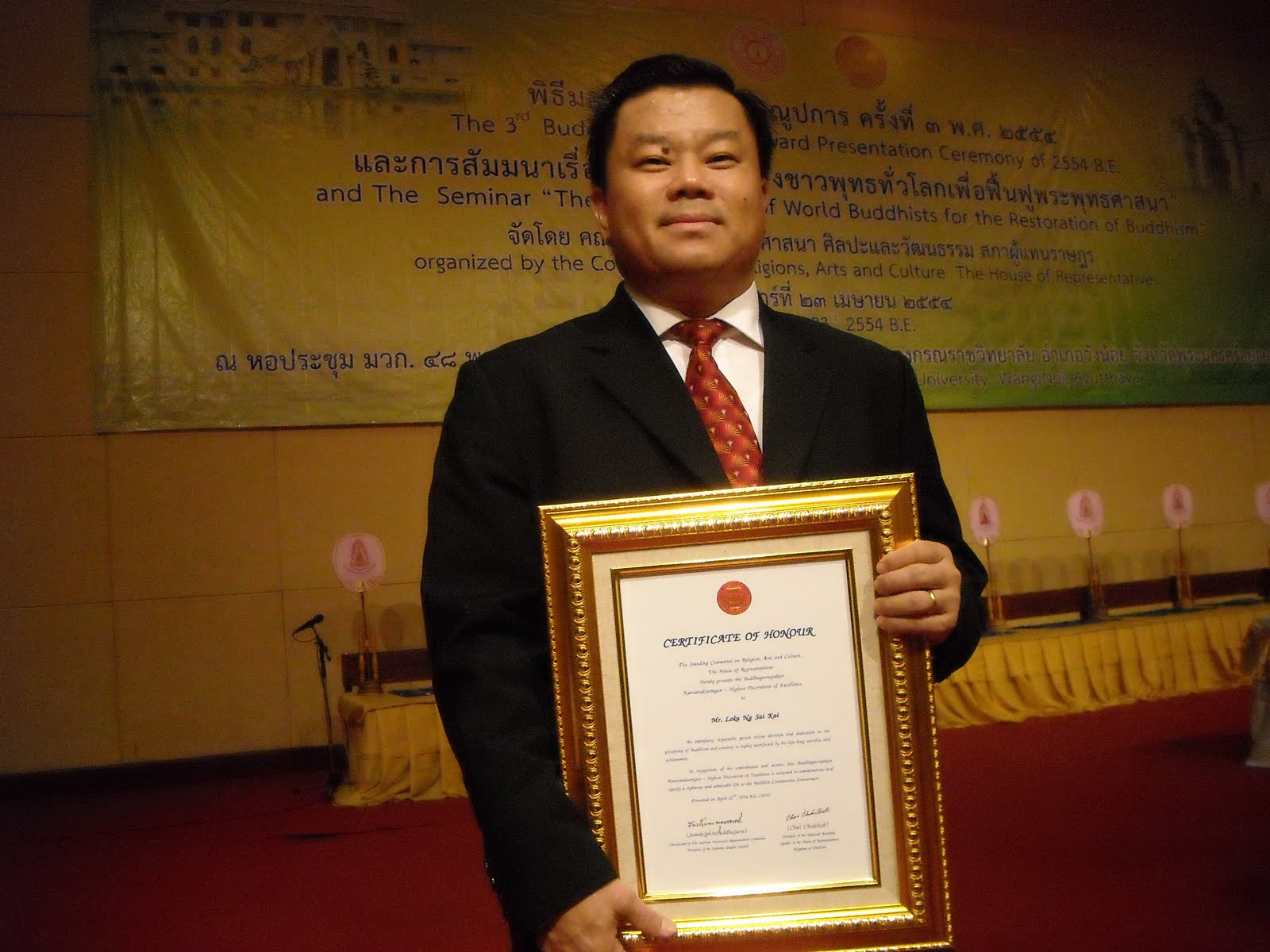
The Standing Committee on Religion, Arts and Culture of the House of Representatives, Thailand recently presented 536 Buddhist individuals  and organizations with the Buddhagunupakan Award to recognize the awardees for their exemplary, dedicated and excellent contributions to Buddhism.

With the Buddhagunupakan Kancanakiartigun presented by the Thai Parliament.

The award presentation which was held on 23 April 2011 at Maha Chulalongkornrajavidyalaya University, Ayuthaya, Thailand was presided by His Most Venerable Somdejphramaharatchamangala of the Supreme Sangha Council of Thailand.

With Ven. Hsing Ting (centre) of Fo Guang San and Ven. Dhammakosajarn of Mahachulalongkornrajavidyalaya University

This award has been presented for the last three years for Thai citizens but beginning this year Buddhists from 18 foreign countries were also picked to receive the awards. There are three categories in the award, namely Supreme, Highest and Outstanding Decoration of Excellence. There were 17 receipients for the Supreme category, 195 for Highest category and 324 for Outstanding category.

Among the notable foreign recipients for the Buddhagunupakan Supreme Decoration of Excellence were Most Venerable Thich Nhat Hanh from Plum Village, France and Most Venerable Hsing Yun of Fo Guang San, Taiwan.

Fellow awardees from Taiwan, Mongolia, Malaysia and Thailand

For the Buddhagunupakan Kancanakiartigun - Highest Decoration of Excellence, foreign awardees include the first President of the Republic of Kalmykia Kirsan Ilyumzhinov; Most Venerable Ching Yao of Taiwan; Most Venerable Gyana Ratna Bhikkhu of Bangladesh and Most Venerable Daranagama Kusaladhamma Nayaka Thero of The Buddhist TV Channel, Sri Lanka.


Malaysians who were conferred the Buddhagunupakan Kancanakiartigun award include Loka Ng Sai Kai, former deputy president and currently advisor of the World Fellowship of Buddhist Youth and Ong See Yew, the president of Young Buddhist Association of Malaysia.

Monday, January 17, 2011

Title and dignity


Panglima Jasa Negara (PJN) awarded by Yang Di Pertuan Agong

A title means many things to different people. Some will go to great length to obtained whatever title that they can possibly get or be conferred by the relevant authorities. Some will search online for degree mills available through the internet to purchased a degree or doctorate so that they can affix the BA, MBA or PhD after their name. Some will unashamedly print their online purchases on their business cards!

For people living in Malaysia, stories of some "selected few" especially paying a tidy sum to middlemen in exchange for their names to be listed in the annual list of royal conferment are as normal as buying goreng pisang or burger from stalls available in every town.

On the political front, some politicians are known to have declined to accept any royal awards while they are still in service of the people. In the contrary some greenhorn politicians who are just few years in politics and barely reached 30, already clamouring for a "Datukship".

But then there are those who declined even to be nominated or awarded with any titles, disregarding the level of importance of the titles. There are few occasions when some people I know who  has worked selflessly for Buddhist NGOs flatly declined to be nominated. This is even after trying to convince them that they are more than qualified and deserving to be nominated after all their years of service and contribution to the country and community. Furthermore any conferment of awards by the state and country to them is also can be seen as an recognition of the organisations or community they represents.

But then there is always two sides of a coin, especially awards for those wearing religious robes.

Darjah Setia Pangkuan Negeri (DSPN) conffered to Ven Chuk Mor in 1998
 
When the late Dharma Master Venerable Chuk Mor was conferred the Darjah Setia Pangkuan Negeri ( DSPN) which carries with it the title "Datuk"  by the then Penang Governor in 1998, there were detractors who felt Buddhist monks should not accept any worldly title of this sort.  Others in the community on the other hand were elated and proud that at last a leader of the Buddhist community in the robe was recognised for  his contributions to society and the state. Even though Venerable Chuk Mor did not attend the conferment ceremony, the award was presented to him by the then Chief Minister of Penang Koh Tsu Koon at the Triple Wisdom Hall Penang.

The Johan Setia Mahkota (JSM) which were awarded to the late Ven Dhammananda, Ven Kim Beng and Ven Keng Ang. This award does not carries any honorific title. Meaning no "Datuk" in front of the recipient name.
 
There were other senior monks who had passed on and known to have been conferred royal state or national awards. Ven Dr K Sri Dhammananda Nayaka Maha Thera was awarded Johan Setia Mahkota (JSM) from His Majesty Yang DiPertuan Agong in 1991. The late abbot of Petaling Jaya  Kwan Yin Teng, Ven Keng Ang awarded JSM in 1995, and the former Malaysian Buddhist Association (MBA) president Ven Seck Kim Beng was also awarded JSM by His Majesty YDP Agong.

Not sure about the other two monks but the late Ven Dr K Sri Dhammananda who was the then Chief High Priest of Malaysia and Singapore and Chief Incumbent of the Buddhist Maha Vihara  did not attend the conferment ceremony at the Istana Negara but the JSM award was presented to him at the Buddhist Vihara by a palace official.

A conferment ceremony at the palace is full of grandeur especially when full palace protocol are observed. As ordinary layman who is still very much attached to worldly sights and experience, it is an opportunity and experience that forms part of life journey in. How often will one missed a palace ceremony to receive an award from the King or Sultan's if given the opportunity? Unless there are more critical matters to attend to or need to be taken for considerations, for sure not many layman will give it a miss.

Pingat Pangkuan Negara (PPN) awarded to the 80+ years old teacher by the YDP Agong

In one of the conferment ceremony that I attended few years ago at the Istana Negara (King's Palace), there was one 80+ years old  former teacher who was awarded smiliar award that I received that year.  Even though the award was one of the lowest level of recognition in the awards hierachy, the old man in full lounge suit and black leather shoes strived and walks slowly to the throne to accept the medal. That's really a recognition and well deserving medal for him. I am sure it was a happy and proud moment for him and his family. - Loka


Note:
As per palace protocol, every awards recipient are expected to follow official dress code as prescribed in the palace guideline issued to every recipient before the ceremony. Layman are expected to wear baju Melayu or either full dark lounge suit with collared white shirt and black leather shoes. There is also another category of attire that can be worn, which is based on the official ceremonial attire of the person's occupation or position like those in the defence or government services. Elected officials and those with honorific titles will be donning their official attire.  Foreign diplomats are expected to wear their official dress.
 

Thursday, December 9, 2010

Public hearings just for window dressing

Below is the full press statement issued by the Selangor Buddhist Development Committee (SBDC) in regards to the lack of response from the local authorities towards the objections submitted by the Buddhist community on the Draft Local Plans 2020 by the relevant authorities.  About 40 Buddhist community leaders and devotees were present during the press conference. The Press Conference was held on 9 Dec 2010 at the Subang Jaya Buddhist Association which was chaired by Loka Ng Sai Kai, Chairman of the SBDC.

PRESS STATEMENT

Local authorities lack of response towards the public hearing objections on the Draft Local Plan 2020(Lack of Structural Provisions for Buddhist Places of Worship)

9th December 2010

SBDC (& its precursor, Buddhist Committee on MPSJ Local Draft Plan 2020) had submitted the objections with over 4000 signatories on January 28th 2008. The MPSJ DLP 2020 public hearing was held on June 22nd 2009. The Public Hearing Panel Chairman YB Iskandar Abd Samad stated the Selangor State Planning Committee (SPC) would decide if the objection(s) were relevant, if not, be discussed on a case-by-case basis (Attachment 1). SDBC submitted a letter (Attachment 2) to enquire the matter on June 10th 2010 but received no response. The gazetted MPSJ Local Plan 2020 is expected to be published soon with minimal considerations to SBDC’s proposals and objections (Attachment 3).

SBDC subsequently submitted similar objections to the MPS, MPAJ, MPKj, MDHS & MDKL DLP 2020 on January 31st 2010 (Attachment 4). To date, SBDC had attended the MBPJ, MDHS, MPS, MPKj & MPAJ Draft Local Plans 2020 public hearings on March 8th, June 14th, June 28th, July 8th & Nov 1st 2010 respectively. On all occasions, the Chairman YB Iskandar Abd Samad, accompanied by the Selangor Jabatan Perancangan Bandar & Desa Semenanjung (JBDS) director, Datuk Mohd Jaafar Mohd Atan, mentioned that SBDC would be consulted further on their objections. However it is with huge disappointment that SBDC was never invited for further consultations and NO such discussion(s) with any of the above-mentioned local councils had taken place since then.
Furthermore, responding to the authorities’ indifference attitude, more than 1023 residents of Putra Heights & USJ Subang Jaya have petitioned to request Datuk Mohd Jaafar to facilitate Putra Heights Buddhist Society’s land applications with the MPSJ and Petaling Land office for an update. There has been NO response or feedback since these applications were made in June & August 2010.
In view of such unfavourable developments which lacks of transparency and accountability, SBDC wishes to highlight the following
1. With reference to religious practice, we urged the State Planning Committee and Jabatan Perancangan Bandar & Desa Selangor to be more vigourous and professional in adhering to its own guidelines in relation to the provisions for building of places of worship for non-Muslims, which is one place of worship for every 2,600 devotees or 5,000 residents.

We emphasized that there are needs for more free-standing Buddhist temples (Vihara Buddha) with sufficient facilities to cater for the spiritual and religious education needs of the Buddhist Community in Selangor.
2. SBDC (& more than 4000 Buddhist objectors) urged the relevant authorities to be fully accounted for and explain why MPSJ (& other local councils) have NOT seriously considered SBDC’s objections. As such, the communiqués and consultation for their decision(s) MUST be done with more transparency and accountability.

We therefore seek the State Planning Committee to take cognizance of this matter seriously and listen to the voice of the people.
3. SBDC reiterates our objections to the usage of the term “Rumah Ibadat (tokong / vihara / kuil / gereja / gudwara )” in Draft Local Plan Majlis Perbandaran Selayang 2020 & all other draft local plans in Selangor. This will further dilute the Buddhist Vihara structural provisions in these local draft plans.

4. SBDC also urges the SPC, Selangor Land Office and the Jawatankuasa Hal Ehwal Selain Islam Negeri Selangor to clearly elucidate in writing the gazette mechanisms & provisions of land for non-Muslim places of worship.
We hereby stressed that the SBDC are prepared to engaged and work closely with the State and the relevant authorities for Buddhist temples to be built on land allocated by the Selangor State Government which are designated for places of worship. As stakeholders in this state, all we seek is the State government’s attention, understanding and compassion towards the needs of our community to have proper land to build and manage our Buddhist temples.

Saturday, December 4, 2010

Buddha's Vacana on race supremacy

Are a person's birth, race, culture and religion the criterias to dictates one's supremacy and nobility over others? Many years ago during my university days when I began to study the Sutras which are the teachings of the Buddha as retold by His disciple. One of the earliest sutra which I studied was the Vasala Sutra (Discourse on Outcasts). The last verse of the said sutra which I still remembers by heart is as follows:

"Not by birth is one an outcast;
not by birth is one a Brahmin.
By deed one becomes an outcast,
by deed one becomes an Brahmin."

The term Brahmin denotes a certain caste or class of people who are considered the nobles and are positioned higher than other castes in the society in India especially in olden days.

So when certain people of certain race from certain area starts to claim they are more supreme than others due to their race and place of birth, it makes me wonder what will happen if each and every race and tribe in the world also declares they are a class above all and more noble than others. Will there be a Nobility Olympics so that each race competes against each other to decide who is the "noblest and supreme" of them all. Just like the Winter and Summer Olympics, there should be many events. The events can include the Best in Shouting Aloud, Most Publicity Seeker, Most Intimidating, Most Racist, Most Extreme, Most Rabble Rousers, Most Nonsensical Statements, Most Opportunists, Highest Mob Mentality, Smallest Pea Brain and whatever long list of other events that can be cooked up by these self declared "nobles and supremacies". But I doubt it will include most respectable, most decent, most well behaved, most polite, most dignify, most intelligent, most understanding and more importantly, Most Wise. - Loka


Discourse on Outcasts

Translated from the Pali by Piyadassi Thera


Thus have I heard:
On one occasion the Blessed One was living near Savatthi at Jetavana at Anathapindika's monastery. Then in the forenoon the Blessed One having dressed himself, took bowl and (double) robe, and entered the city of Savatthi for alms. Now at that time a fire was burning, and an offering was being prepared in the house of the Brahman Aggikabharadvaja. Then the Blessed One, while on his alms round, came to the Brahman's residence. The Brahman seeing the Blessed One some way off said this: "Stay there, you shaveling, stay there you wretched monk, stay there you outcast." When he spoke thus the Blessed One said to the Brahman: "Do you know, Brahman, who an outcast is and what the conditions are that make an outcast?" "No, indeed, Venerable Gotama, I do not know who an outcast is or the conditions that make an outcast. It is good if Venerable Gotama were to explain the Dhamma to me so that I may know who an outcast is and what the conditions are that make an outcast."

"Listen then, Brahman, and pay attention, I will speak."
"Yes, Venerable Sir," replied the Brahman.

1. "Whosoever is angry, harbors hatred, and is reluctant to speak well of others (discredits the good of others), perverted in views, deceitful -- know him as an outcast.

2. "Whosoever in this world kills living beings, once born or twice born, in whom there is no sympathy for living beings -- know him as an outcast.
3. "Whosoever destroys and besieges villages and hamlets and becomes notorious as an oppressor -- know him as an outcast.

4. "Be it in the village, or in the forest, whosoever steals what belongs to others, what is not given to him -- know him as an outcast.

5. "Whosoever having actually incurred a debt runs away when he is pressed to pay, saying, 'I owe no debt to you' -- know him as an outcast.

6. "Whosoever coveting anything, kills a person going along the road, and grabs whatever that person has -- know him as an outcast.

7. "He who for his own sake or for the sake of others or for the sake of wealth, utters lies when questioned as a witness -- know him as an outcast.

8. "Whosoever by force or with consent associates with the wives of relatives or friends -- know him as an outcast.

9. "Whosoever being wealthy supports not his mother and father who have grown old -- know him as an outcast.

10. "Whosoever strikes and annoys by (harsh) speech, mother, father, brother, sister or mother-in-law or father-in-law -- know him as an outcast.

11. "Whosoever when questioned about what is good, says what is detrimental, and talks in an evasive manner- know him as an outcast.

12. "Whosoever having committed an evil deed, wishes that it may not be known to others, and commits evil in secret -- know him as an outcast.

13. "Whosoever having gone to another's house, and partaken of choice food, does not honor that host by offering food when he repays the visit -- know him as an outcast.

14. "Whosoever deceives by uttering lies, a Brahman or an ascetic, or any other mendicant -- know him as an outcast.

15. "Whosoever when a Brahman or ascetic appears during mealtime angers him by harsh speech, and does not offer him (any alms) -- know him as an outcast.

16. "Whosoever in this world, shrouded in ignorance, speaks harsh words (asatam) or falsehood expecting to gain something -- know him as an outcast.

17. "Whosoever debased by his pride, exalts himself and belittles others -- know him as an outcast.

18. "Whosoever is given to anger, is miserly, has base desires, and is selfish, deceitful, shameless and fearless (in doing evil) -- know him as an outcast.

19. "Whosoever reviles the Enlightened One (the Buddha), or a disciple of the Buddha, recluse or a householder -- know him as an outcast.

20. "Whosoever not being an Arahant, a Consummate One, pretends to be so, is a thief in the whole universe -- he is the lowest of outcasts.

21. "Not by birth is one an outcast; not by birth is one a Brahman. By deed one becomes an outcast, by deed one becomes a Brahman.

22. "Know ye by the example I now cite (the fact that by birth one is not an outcast). There was an outcast's son, Sopaka, who became known as Matanga.

23. "This Matanga attained the highest fame so difficult to gain. Many were the warriors (kshatriyas) and Brahmans who went to attend on him.

24. "Mounting the celestial chariot (the Noble Eightfold path, and driving) along the passion-free high road, (Sopaka, now a monk), reached the Brahma realm having given up sense desires.

25. "His (lowly) birth did not prevent him from being reborn in the Brahma realm. There are Brahmans born in the family of preceptors, kinsmen of (veda) hymns.

26. "They are often seen committing evil deeds. In this life itself they are despised, in the next they are born in an evil state of existence. High birth does not prevent them from falling into a woeful state, or from censure.

27. "Not by birth is one an outcast; not by birth is one a Brahman. By deed one becomes an outcast, by deed one becomes an Brahman."

When the Buddha had thus spoken, the Brahman Aggikabharadvaja said to the Blessed One: "Excellent, O Venerable Gotama, excellent! Just as, O Venerable Gotama, a man were to set upright what had been overturned, or were to reveal what had been hidden, or were to point the way to one who had gone astray, or were to hold an oil lamp in the dark so that those with eyes may see things, even so in many ways has the Venerable Gotama expounded the Dhamma, the doctrine. I take refuge in the Venerable Gotama, the Dhamma, and the Sangha, the Order. May the Venerable Gotama accept me as a lay follower who has taken refuge from this day onwards while life lasts."

Tuesday, November 23, 2010

Turning around Sri Lanka

After going through years of internal strife that causes the economy to tumbled, Sri Lanka is set to forge ahead after peace arrives two years ago. After years of arm conflict against the Liberation Tigers of Tamil Eelam ( LTTE), Sri Lanka is now going through a renewal and reconstruction process which expected to bring more development to the country.

It is with high hopes that the people of Sri Lanka re-elected the popular President Mahinda Rajapakse for a second term of office months ago which inauguration ceremony was held last Friday near the sea front.

The last time I went to Sri Lanka was more than 10 years ago and the impression that Colombo, the capital city gaves me was a very tense feeling to be at the place that time. During the flight home after attending the World Fellowship of Buddhist Youth 16th General Conference recently, an Sri Lankan engineer in his 30s sat beside me. He is visiting his supplier in Subang Jaya to quality check on the lamp posts which his company is procuring from the Malaysian factory. His company was recently awarded a contract by the Sri Lankan government to built new street lightings along Colombo city roads as part of the re-construction process.


During the flight, he confided that before the LTTE was decimated, his mother was always very worried each time he walks out from home as bombings were happening regularly in Colombo and he might be the next victim as the bombings usually claims innocent pedestrians and members of the public. Now the fear is at the minimal as bombing in public places has been close to non existence for the last two years.

Many lives has been lost due to the 30 years internal strife. It would not be surprising if every Sri Lankan has lost at least one of their family members or known of someone who lost some love ones to the war. The three wheeler or "tuk-tuk" driver who fetch my Thai buddy Anurut and myself to the McDonalds also lost one of his brother to the war.

With his second term in office just being officially inaugurated, President Mahinda Rajapakse gripped on the country's future is as firm as ever and his leadership is expected to bring the long overdue progress to the people of Sri Lanka where about 77% of  of them are following the Buddhist faith. - Loka

Sunday, July 18, 2010

Residents appeal for a Buddhist temple


It was about one in the afternoon and was raining heavily in Bukit Tinggi, Klang. But it did not deters a group of residents from the Bandar Bukit Tinggi housing estate to come out in umbrellas to put across their appeal to the Selangor state government to allocate a piece of land in the area for a Buddhist temple to be built there. The devas must be shedding tears of support for a Buddhist vihara in Bandar Bukit Tinggi!

In that area, a piece of land with the size about 28,000 sq ft has been designated for use to build a place of worship for the non-muslims. A local Buddhist organisation, the Mudita Buddhist Society has submitted application in early 2009 for that piece of land to enable the society to build a Buddhist temple. Considering that nearly 70% of residents in the surrounding areas are of the Buddhist faith, it is not too much too ask for a place of worship to be built there. Furthermore, within the vicinity there is not even one Buddhist temple to serve the spiritual and religious education needs of the Buddhist community.

Buddhist community in Malaysia are usually quite subtle in approaching the government for land to build temples or solving issues related to their religion. For a group of residents to come out in the rain to request the government to listen to their needs, this must be a matter of serious concern to them and close to their heart.

Therefore the Selangor state government are strongly urged to consider approving the land application by the Mudita Buddhist Society so that the religious needs of the community will be taken care of. The people already spoken, what say the state government? - Loka

Friday, July 9, 2010

Is Buddhist population declining in Malaysia

Basing on the report on the National Population Census 2000, Malaysian citizens of the Buddhist faith comprised 20.2% of the total citizens of the country.

The National Population Census 2010 was launched this week and enumerators are going from house to house to conduct the census. When the census are over and report published, what will be the number of Buddhists in this country? Will it increased, reduced or remained the same? If the percentage increases, will it be due to natural procreation amongst the Buddhist populace or the results of persistent missionary activities by Buddhist groups in the country.

But if the percentage drops, what will be the reasons that causes the number of Buddhists in Malaysia declining? Maybe Buddhist parents did not teaches their children their own religion? Or the Buddhist monks, nuns and lay preachers did not work hard enough for the last ten years? Or the loss of the followers due to conversion to other religions or they just declared themselves as not adhering to any religion.

If the percentage and total reduces due to the possibility of more people declaring themselves as no-religion or atheist, then the situation can be serious enough for all stake haolders in the Buddhist community to do the necessary to educate these Buddhist-by-birth to know more about their own religion.

As the national population census report will be used as a reference to help the government to plan for the country development in different sectors, the numbers of Buddhists in the country will be taken into consideration when the federal and state governments deliberate on the need of the community. This is especially so in matters related to the allocation of religious land and also financial allocation to built and maintain Buddhist temples.

As numbers speaks for itself, it is therefore very urgent and most important for all Buddhist temples and centres in the country to urge their devotees and those once-a-year (Wesak) Buddhists to declare themselves as Buddhists in the census form. - Loka

Thursday, June 24, 2010

Silence of the monks

When news on the Malaysia Nibbana Meditation Center debacle re-emerged recently in an English daily, it also re-ignites a larger challenge faced by the Buddhist community in the country.

Unlike many countries with significant numbers of Buddhist populace like Cambodia, Sri Lanka, Thailand, Nepal and some others, Malaysia does not have anyone which holds the title of the Supreme Patriach or Sangharaja who leads the overall Sangha community. Even though some may argued that there are Chief monks, Chao Kun, leader of monks association and so on, these are debatable as all of these titled monks only lords over their respective traditions, lineage and community. In short, there is no such thing as a Supreme Patriach or Sangharaja in the Malaysian Buddhist Sangha Order which all members of the Sangha community respects and honour and submitted to its authority.

The widely used English language title of Chief High Priest of Malaysia meant little to those who follows the Mahayana traditions while those who follows one particular lineage may not endorsed another leader from a different lineage in the Vajrayana traditions. Monks from the Thai Buddhist temples will be reporting to their chief monk or Chao Kun. As for the little-known Malaysia Buddhist Sangha Council, any monk holding the president position does not automatically designates him as the leader of all monks in Malaysia. The position is just another "good to have" title without any real authority to administer over the dicipline and managements of monks in the country.

For the last one century of Buddhism in Malaysia, the closest any Sangha member who can be considered the de facto leader of Buddhists ( Sangha and laities alike) who are able to influence and provide leadership to monks of all traditions and lineages is the late Venerable Dr. K Sri Dhammananda Nayaka Maha Thera. Venerable Dhammananda, who was the Chief monk of the Buddhist Maha Vihara, was able to gained respect and recognition from all groups in the Buddhist community due to his Dhamma knowledge, wisdom, compassion and encompassing personality rather than as the Chief High Priest of Malaysia and Singapore, a title bestowed by the Sri Lankan Theravada Sangha.

In the current scenario, any monk or monks who breaks any major Vinaya rules will most probably get away scot free from any action being taken against them if he claims he is not part of any Sangha community and does not submit to any so-called Sangha authority. There is no laws in the country that can compels any renegade monks that deviated from the Vinaya and the Buddha's Teachings to be disrobed or have any disciplinary action taken against him. This is sad but true state of affairs.

The MNMC issue again highlighted the acute deficiency of a proper and all encompassing monks management system under the authority of a respectable and supreme Sangha body in this country. As mentioned in the other article here, the catalyst to the current situation can be traced to the interpretation of the Vinaya, not the laws governing the MNMC as a registered organisation.

The group which are seeking the "re-opening" of the meditation centre has been leaving no stones unturn to return the centre to the people. This group has approached many senior monks, community elders and various Buddhist organisations and temples in their quest for a solution to the current situation but to no availed. It seems they even networked with overseas Buddhist cleric for support and guidance. They also had approached the relevant authorities to help out in this predicament.

On the other hand, the group which is now in control of the centre are practising their "silent meditation" in response to events which unfolds outside the centre. Their stance are clearly based on the fact they are the legal custodians of the centre in the eyes of the Registrar of Societies. They are praying that by keeping silent and secluding themselves for certain duration, the group outside will slowly wavered and the drive to pursue on the matter will wear off.

But after four years it looks like the situation is still as vibrant as ever. The group inside is still practising their "silent meditation" while the group outside is still pursuing the matter by seeking the Buddhist community's intervention especially the Malaysia Buddhist Association (MBA) and Young Buddhist Association of Malaysia (YBAM).

While the MBA who are mostly led by monks had put in some efforts to sort out this matter;  YBAM which is a lay Buddhist youth organisation has been reluctant to get involved due to some perplexed reason of not wanting to upset the organisation panel of advisors. Is this puzzling excuse connected to the fact that co-incidentally one of YBAM's advisor is also a senior founding member of MNMC who had let down the centre's devotees by not discharging his responsibilities fairly and effectively in solving the matter amicably during the onset of the debacle?

Even though the effort is laudable, the initiative of the Malaysia Buddhist Association to pass the buck to its panel of lawyers to find a solution to the current sticky situation in MNMC reflects the lack of will and lost of direction as a national Buddhist organisation to find a Dharma-based solution on a Vinaya interpretation. It is indeed a sad reflection on the state of Buddhist leadership or specifically the Sangha leadership (if there is any) in this country when a Vinaya problem which involves members of the Sangha are unable or unwilling to be handled by the Sangha but pushed to a panel of lawyers who are all lay people.

Taking the cue from this case, the question now is whether the concept of the monk-laity relationship is being re-defined where the monks now are seeking the lay people to mediate on monks problems when it should be the responsiblities of the Sangha to sort out their own state of affairs. In the absence of an authoritative figure or committee, can the Sangha really effectively manage their own community in this country?

But then how much can the Buddhists in this country expects from the Sangha to solve their own problem? Looking back at some incidents in recent times, how often did the senior Sangha put their foot down to resolve controversies related to members of the Sangha? For example, in a recent case of a monk who held a senior position in a national Buddhist youth organisation, the monk allegedly used his position to instruct his students in holiday workcamps to perform actions which are contrary to the Vinaya. Senior monks from the same lineage who are aware of the horny monk character, did not take any strong and effective actions against him until some of his victims and concern Buddhists initiated plans to make public his actions.

The case above is similiar to another case which happens about two decades ago where one popular monk was alleged to have broken certain Vinaya rules. At the end of the day the embarrasing incident was sorted out and defused not by other senior monks but by the laymen themselves particularly members of the centre where the said monk resided. As usual, the Sangha leadership role in sorting out this issue was negligible and disappointing.

It is estimated that there are about 1,500 Buddhist temples and centres in  this country with slightly more than one thousand Buddhist monks of different traditions residing in their respective temples and centres. No one can guarantee similiar incidents implicating monks that broke the Vinaya rules will not occur again but if there exist a strong and effective Sangha leadership, at least any situation can be nipped at the bud and the matter solved amicably without having it splashed in the frontpage news, causing mental discomfort and embarrassment to the affected individuals and the Buddhist community.

Those who are sitting at the pedestal of the Sangha community must step forward to resolve the MNMC issue and other issues related to those in the holy robes. While it is the responsibilities of the laity and Sangha to protect and pro-long the Buddha-Dhamma, the Sangha must be in the forefront to protect the sanctity of the Sangha. Anything less than that, let the law of karma take its own course. - Loka

Thursday, June 10, 2010

When monks confused devotees disillusioned

It would not be surprising if members of the public are curious to know which meditation centre the English daily The Star was referring to with regards to the front page news published in Wednesday's edition. Furthermore, since it involved Buddhist monks, this matter surely caused concern to the Buddhist community especially those who are in leadership positions in Buddhist temples or organisations who are expected to protect and uphold the sanctity of the Triple Gem, which includes the Sangha or the community of monks.

To avoid other meditation centres or temples within the vicinity in Kajang being mistakenly linked to the top story of the daily, let it be known that the said centre is the Malaysia Nibbana Meditation Centre (MNMC)which is based in Kajang. The issue regarding the management of the MNMC bungalow cum meditation centre has been in existence since 2006. The centre used to draws huge crowds to its religious sessions and programs. Many local university students in the vicinity also troops into the centre to learn from its founder monk, Venerable Kai Chow.

In the early days when he just started to set up base in Kajang, Ven Kai Chow visited the Sungei Jelok Prison regularly where he provides counselling and Dharma teaching to the prisoners including those in the "Death Row". His works with the prisoners are well known especially amongst the Buddhist community. A compilation on the feelings of the prisoners published by him some years ago was in hot demand after its publication.

In perspective it does not really need much "probing" as what The Star claimed to do as this centre's matter are well known to many Buddhist organisations and community leaders. Furthermore those who reads Chinese vernacular newspapers might have also come across this front page "scoop" sometime ago which is already a stale story that the Chinese press now does not even take it as newsworthy to be published anymore. It is just curious how does the editorial team in The Star decides to front page an outdated story which the Chinese vernacular press already dumped long ago? Or is there any other agenda which only The Star knows?

From the surface, especially for those uninitiated, the said newspaper article was made out to looks like two groups are fighting over the control of MNMC's list of landed properties especially the centre in Kajang but the reality is that the catalyst to the current situation facing the centre did not arise out of any intention to wield control over any of the assets. The situation that created the sparks and caused the centre to go through what is happening today can be traced to different interpretation of the Vinaya (Code of Discipline for monks) by two conflicting school of thoughts. On one side is the centre's founder monk (who already left the centre) while on the other side is a group of six monks who still resides in the centre. Co-incidentally four of the monks still residing in the centre were the disciples of the founder monk. The issue on the control of the assets was an after thought.

Basically a situation which arises from two conflicting views on the Vinaya between the monks spread to the devotees of the centre. In the end the centre's devotees began to take sides and split into at least two conflicting groups. What's happening now concerning the centre are spillover from actions of the members of the Sangha. In the context of the Buddhist teachings, any problems within the Sangha community should be deliberated and solved within and by the monks themselves, preferably with the guidance of learned senior monks within the Sangha.

Lay devotees should not have been dragged into this matter which creates more animosity and frictions within the centre's community which is totally unbecoming in a religious community that vows to uphold and practice the Noble Eightfold Path. The Sangha should be the cause of unity and wisdom not creator of frictions and disillusion in the Buddhist community or any community at large. - Loka


The Star, Wednesday June 9, 2010


Meditaton centre built with public funds now a ‘country club’

By LEE YUK PENG
yukpeng@thestar.com.my

PETALING JAYA: The bungalow, nestled in a secluded spot amidst dense greenery, is supposed to be a temple that was built on public donations.
But accusations have surfaced that the “meditation centre” in a Kajang neighbourhood has been operating like a country club – open only to its estimated 30 members.
Almost 100 Buddhist devotees have been asking for the re-opening of the temple, built in a sprawling leafy area, since last year.
Their petition is seen on a website which was started last year by several former university students who once volunteered at the place.
According to them, the centre has been closed to the public since October 2006. The priest, who was the founder, quit that year.
The latest posting on the blog was dated May 29. It showed photographs of the centre, taken from outside its gate, where a CCTV was also installed there.
It is believed that several monks are residing in the centre now.
One of them, when contacted, was hesitant to elaborate about its recent Wesak Day celebration.
“We have our own things to do here,” he said, declining to reveal his name.
Shady place: The entrance to the centre in Kajang is cluttered with dead leaves and the entire place is covered in foliage.
A volunteer, who once helped to coordinate activities of the centre, spoke of her heartache of what the place had now become.
“We started it from scratch. Devotees helped to collect donations to buy the land for the centre,” she said.
According to the former volunteers, the centre sits on a 1.8ha piece of land which was bought from a developer with 50 guarantors in 2001 at RM2.3mil. This was fully paid up in 2004.
According to the website, the centre has another five plots of land elsewhere. The volunteers had sought the services of a valuer, who estimated that all the assets could be worth about RM10.8mil.
Previous news reports indicated that the centre once had about 100 volunteers and attracted 10,000 devotees to its events.
A Hong Kong resident even donated RM100,000 to the centre according to newspaper reports last year.
In its 2008 annual general meeting, members passed a resolution that they would not be seeking an external auditor to audit their accounts.
The centre, the volunteer said, started in 2001 and the priest in charge had a big following due to his community work.
She alleged that things started to go downhill when the monks began to break into factions among themselves.
“Some of the monks even took away several Buddha statues and equipment like loudspeakers,” she claimed, alleging that they brought in gym equipment instead.
Several devotees have lodged a police report about breach of trust but the monks also countered with a report that they had been harassed.
Calls to several officials of the Malaysian Buddhist Association, of which the centre is a member, showed that they were aware of complaints about the centre.
“We are leaving it to our legal team to look into the problem,” one official said.
The devotees have also complained to the Registrar of Societies.
Asked about the centre, registrar Datuk Md Alias Kalil agreed that any place of worship should be open to the public although “in this case, the by-laws of the centre stipulate that it is opened to those deemed as members.”
It is learnt that the ROS will soon be issuing the centre a show-cause letter, seeking an explanation why two laymen were on its committee although its constitution stated that only monks could hold posts.