Friday, August 7, 2009

Let's march for the nation

Malaysia will be celebrating her 52nd year of freedom from colonial powers on 31 August 2009. What is the meaning of this day of freedom ?


Since 31 August is a national public holiday some will take the opportunity to spend more time with their family or beloved ones. Taking advantage on the final day of the Mega Sales Carnival, shopaholics will be swarming the shopping complexes looking for last minutes bargain especially those in big cities crowded with shopping malls. For those who has been sweating it out for the week, the long weekend will the time to have a good rest on the couch.


For those involving in the national day annual parades; brazing through hot suns, inhaling the dreaded haze which is an annual Merdeka gift mostly from our "brotherly" neighbour and drenched by the intermitten rain (not from water cannons though) is already part and parcel of of the package for these patriotic marchers. No worry, those marching along the designated routes will not be sued by the shopowners, KFC, or the goreng pisang and cendol hawkers for causing their sales and profits to drop.


On the contrary, they should be enjoying roaring business from those people that crashed into the parade sites to witness the parade. For sure the ice-cream man and the mamak stalls will be replenishing their stock to fulfill the fanstastic demand. Wonder if these businesses along the routes will share their extra profit with the march organisers since they are the one that brings in more people to the streets.


Why do these people march? No doubt they must be having a valid reason to spend weeks practising and rehearsing their steps marching to the rhythm to ensure nothing went arong so that they can put up a great show on that memorable day. They will be marching as what their forefathers did more than 52 years ago.


Their forefathers marches for a belief, the belief that one day their land shall be free from the clutches of the domineering, high and mighty powers of the day. They dreamt one day they will be able to build a great nation for themselves and their children, and their childrens children. A place where everyone can breathe the same air of freedom with a peaceful mind and hold into their heart that this land will provide a just and equitable opportunity for all to build a happy and comfortable place which they can call home.


Now 52 years later, their sons and daughters will also march to protect the freedom that is promised to all and to remember with gratitude those before them that had sacrificed and dedicated they lives for the nation because they believed it is the right thing to do. On 31 August, for those marching throughout the country, at Padang Merdeka in Kuching, Waterfront in Kota Kinabalu, Dataran Kemerdekaan in Shah Alam, Danga Bay in Johore Bahru, Seberang Prai in Penang and so on, they will be marching with the vigour and spirit of their predecessors. They will march to ensure their freedom will be defended and the right to their religious and cultural practices will be respected and to ensure the destiny of the nation will not falls into the hands of bigots and self serving individuals and parties.


Yes, on 31 August all of us will rise early and raise the Jalur Gemilang under the sun that shines over our land and we shall march together for the freedom, justice, progress and a united nation.


Selamat Menyambut Hari Kemerdekaan ke 52.
Long Live Malaysia! - Loka

Tuesday, August 4, 2009

Monk and horse do ticks

By now many religionists all over the world would have read news about Singaporean monk Ven Ming Yi being charged and stand trial in court for falsifying accounts and giving false information. His trial ends on Monday 3 August 2009 and the judgement is expected to be delivered in October this year.


In all these years many had benefited from the charity work that he had done and appreciated all the efforts he put into to ensure the charity projects are able to sustain and operate smoothly.


All the facts and information in relation to the 5Cs that flows out during the trial would have been accepted by the people in good faith if he has been just a typical CEO, enjoying good life as a successful corporate man.


He would have been a model for exemplary leadership in charity management and high-end social lifestyle but it turns into a controversy because Ming Yi is not wearing a corporate jacket with a tie but a monk's robe with rosary over his neck.


This sort of publicity is not what the people especially the Buddhists is asking for. What makes a "modern" monk? Does it mean living like a layperson and enjoys the good lifestyle and luxuries while wearing a monk's robe. Is this the message for potential samaneras and monks? Go through the rites of passage for monkhood, shaved the head, recites the monks Vinaya, wears a robe, study the Suttas, accepts devotees dana, preach the Dhamma to the devotees, attend Buddhist conferences and meetings, lead temples in different countries and so on and so forth. And not forgetting to have a horse named Venezuela as a pet and owns chic cars. Is there any other type of lifestyles which need to be added?


All this mind boggling actions would not have affected devotees confidence in the Sangha if the person is a layman with businesses in different countries. Many years ago during my university days I heard a lecturer says, when you are a king, act like a king; when you are beggar, act like a beggar and when you are a layman, you may act as you like at your own risk but when you are a monk please respect the robe and protects the Dhamma.


There are many "wished it never happens" stories which did not sees the print in the newspapers because devotees and committed members of the Sangha had put their level best to contain the situation and protect the sanctity of the religion and the monk's robe. We can only share our merits and transfer our aspirations to those that strayed from the path to have Hiri-Ottappa to come back to the right track. Other than that we leave it to their karma and ours too if we did not do anything to rectify the situation and protects the religion. - Loka


Sunday August 2, 2009 The Star
Monk with the 5Cs


By CAROLYN QUEK


Cash, credit card, car, country club membership and condo – the self-confessed modern-day monk has got them all.


A BUDDHIST monk for 25 years, former Ren Ci chief Ming Yi also achieved the Singapore dream of the five Cs.
He had cash – at one stage, he had S$570,000 (RM1.39mil) in his personal bank account.
He had credit cards – at least nine from various banks bore his real name of Goh Kah Heng. He also held at least three supplementary cards for his personal assistant Raymond Yeung.


Lap of luxury: Former Ren Ci chief Ming Yi had a membership at the prestigious The Vines Resort & Country Club in Perth, Australia. — The Straits Times
He had condominium units – he bought and sold at least six private properties in Singapore and Australia over 20 years.
He had cars – he bought at least three BMWs in six years, including one for Yeung.
And he had a country club membership – at the prestigious The Vines Resort & Country Club in Perth.
The spending habits of the monk were revealed in court over the past two weeks, where Ming Yi, 47, and Yeung, 34, face charges of conspiring to falsify a Ren Ci payment voucher and of giving false information.
The prosecution attempted to paint him out to be a spendthrift who was lax with his own money, and possibly that of the charity he founded too.
By his own admission, Ming Yi was a “modern-day monk”.
“Buddhist monks are no longer living in the mountains or in the forest. We are in the city now,” he said when responding to a question about how religious people were very different now.
Apart from the condominiums, cars and credit cards, the court heard how he forked out A$2,000 (RM5,800) every two months to maintain a horse in Perth, spent S$45 (RM110) at a tanning salon in Melbourne, and more than S$l,000 (RM2,440) for a two-night stay in Bintan’s Angsana Resort and Spa.
When quizzed about his horse named Venezuela, Ming Yi said he wanted it as a pet.
“Not many of us in this courtroom are horse owners. Can you tell us the monthly maintenance?” asked Deputy Public Prosecutor Jaswant Singh.
Ming Yi said he could not remember. Receipts produced by the prosecution showed that Venezuela cost him A$2,000 every two months.
He also did not remember buying a BMW540 series with leather seats for about A$163,500 (RM475,000), although his signature was on the purchase form.
At one stage in the trial, Ming Yi admitted being easy with money.
“Were you easy with Ren Ci’s money as well?” DPP Singh shot back.
“No,” said the monk. “Like I said, a lot of religious people, not only myself, are very different now.”
Condominiums
In the late 1980s, the monk bought his first property in Mountbatten Road, financed by donations from devotees and a mortgage loan.
The property, bought for S$1.48mil (RM3.62mil) and sold in 1993 for S$3mil (RM7.34mil), housed Chao Yin Lodge, a Buddhist centre he ran, where his devotees gathered to learn from him.
In 1994, he used money from the sale of the Mountbatten property to upgrade to a S$1.4mil (RM3.42mil) two-storey house in Bedok Ria Crescent, where the lodge was relocated. He paid the amount in full.
A year later, he bought an apartment for S$1.38mil (RM3.37mil) at The Atria in the East Coast. This was an investment to help Ren Ci, he said.
These last two properties were bought at a time when he had just set up Ren Ci and he had earlier stated that they were difficult times for the charity in terms of raising money for its work.
More investments followed, this time beyond Singapore’s shores.
He went to Perth where he bought a plot of land for the Foo Hai Chan monastery, where he is abbot.
“It was my mistake at that time. I should not have purchased the land,” he said. “I think at that point in time, we talked about Foo Hai Chan going further etc, but it did not materialise, so eventually we sold it.”
Before that piece of land was sold, a A$300,000 (RM870,000) house was built on it. He also had a A$1.48mil (RM4.3mil) penthouse, which came with a private lift, in Melbourne.
DPP Singh said: “While you want the court to believe that you were trying to do your utmost where Ren Ci is concerned, you yourself were living the good life in Perth?”
Ming Yi said: “Eventually I did not stay there. I think I was only there three, four times. I don’t really go there.”
The prosecutor pressed on: “Is it okay for Buddhist monks to have properties in various parts of the world? Is that what a modern monk does?”
“There are many people who have that,” replied Ming Yi.
When asked if that was his belief, he said: “I’m not saying that it is a must. That’s why you see after investing in properties and all that, after that I did not want to invest any more because as time changes, my thoughts change as well.”
He said he saw his properties as investments.
Cars, cash and credit cards
BMW appeared to be his favourite brand – he owned at least three of them.
Although he could not remember the first BMW he bought in Perth in 1998, it was black, according to the purchase form.
Another BMW, bought in 2004, was a 5-series and worth about A$128,000 (RM370,000).
The BMW he bought for Yeung was a 3-series worth A$88,000 (RM255,000).
“All along, I liked European cars because they are more steady. That’s why I got myself a BMW,” Ming Yi said.
At one point in 2006, he had more than S$500,000 (RM1.22mil) in his bank account. A large part of this, he said, had been given to him by a devotee making a donation to the Singapore Buddhist Free Clinic.
But he had mounting credit card debts. In May 2004, he owed the banks more than S$70,000 (RM171,200) in unpaid bills.
But his lawyer, Senior Counsel Andre Yeap, pointed out that his client had made only one luxury purchase from 2001 to 2006 – an item from Hugo Boss costing more than S$560 (RM1,370).
The bulk of the credit card spending was apparently done by Yeung, who spent thousands shopping at Hermes, Louis Vuitton and Ermenegildo Zegna.
The court was also told that Ming Yi and Wee Beng Seng, an ex-treasurer of Ren Ci, were joint members of the Vines Golf & Country Club in Perth.
DPP Singh described it as “one of the more upmarket resorts in Western Australia”.
A total of A$27,990 (RM81,000) was paid in July 1998 for Ming Yi and Wee to join as members. Subsequent annual fees for international membership stood at a total of A$990 (RM2,800).
The court heard that during an outing at the Burswood Casino, also in Perth, two withdrawals of A$900 (RM2,600) were made one night. Ming Yi claimed that Wee had made the withdrawals.
He later said that Wee, a former drug addict whom he counselled at a drug rehabilitation centre in the 1980s, would make occasional trips to casinos when overseas, but that he was not a compulsive gambler.
Charity was close to his heart
While Ming Yi looked sheepish and at times exasperated when grilled about his lifestyle, he spoke passionately about another C – his charity.
He spoke at length about his “baby” Ren Ci and how the whole cover-up about a S$50,000 (RM122,300) loan was meant to protect the charity’s reputation.
After witnessing the public backlash from the National Kidney Foundation scandal in 2005, he did not wish the same fate to befall Ren Ci.
“Yes, I knew it was wrong (to cover up the loan) ... if there was a poisonous snake that crept into the building and a lot of people are there and the bite can kill, I might kill the poisonous snake,” he said.
“Although I was wrong, I was looking at the big picture of Ren Ci. I did not want any more harm to Ren Ci.
“Because in Buddhism, we are supposed to abstain from killing, we are not supposed to kill. But, however, to save more people, I would just have to kill the poisonous snake.”
DPP Singh said: “Were you looking after yourself?”
Ming Yi replied: “I had to look after myself in order to look after others.
“I think when you talk about impermanence, even in a modern-day monk, in a modern-day world, in a modern-day society, which you talk about impermanence, the properties that I may have, I have sold them, the money that I may have, I will lose them at the end of the day. I will not always cling to it. That is impermanence.”
To this, the prosecutor said: “Now Venerable, I want to put it to you, your public persona is that you were selflessly committed to Ren Ci and Foo Hai Chan and you were anxiously trying to find monies.
“On the other hand, you were trying to hide your private persona, which is luxury living in Perth and two properties in Singa­pore.”
Did Ming Yi believe in luxury, DPP Singh probed the monk.
Ming Yi said he would be perfectly comfortable living in a village in Sri Lanka, China or Thailand.
“I think actions speak louder than words. The people in Foo Hai Chan, the people in Ren Ci would know what I’ve done.”
DPP Singh commented: “Indeed, your actions spoke louder than your words in Perth.”
The monk replied: “I had my flaws, yes, I agree, but that does not mean that I am not taking care of Ren Ci Hospital and Foo Hai Chan monastery.”

Monday, August 3, 2009

Chief monk resigns

The BMSM elected a new team to lead the society for the next two years. Chee Peck Kiat was elected president replacing Ang Choo Hong who calls it a day. The lineup includes vice presidents Patrick Phoon, Chua Chong Kee, Soon Koi Voon and the only female Loh Pai Ling. Jeffrey Pang won the secretary general position uncontested while Ng Lai Peng elected the new treasurer, also unopposed.

Out-going president Ang Choo Hong


Other new office bearers are assistant secretary Kong Tin Lai, assistant treasurer Looi S.K and committee members Quah Chi Boon, Yong Kut Seng, Hemadasa, Pau Kiew Wu, Ng Hong Pau, Goh Seng Chai, Sarath Surendre, Wong Ong, Chang Lam Yen, Lim Chee Keong, Chan Tien Fu and Selina Lim.


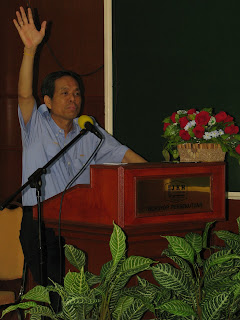
In-coming president Chee Peck Kiat


The meeting dragged on for five hours due to some contentious issues spilled over from the previous annual general meeting. There was even a proposal for certain item in the minutes to be expunged! Wow, if in every meeting certain parts of the meeting are to be expunged when anyone do not agrees with it then in future historians will not have any reliable reference to refer to do their writing since everything has already been expunged!

The new secretary general Jeffery Pang already started his duty earlier


Sadly the annual meeting which is supposed to enable members to participate and provide inputs for the development of society was turn into a "battle ground" between certain individuals and groups. Claims and counter claims were hurled at each other on the protracted issue of unauthorised printing of receipts books with the name and logo of BMSM which was used to collect fund from the public.


Anymore nominations? Returning officer Jerry Khoo calls out.


One member who is also a president of another organisation even accused the BMSM president for implying that he is telling a lie! One member even "threatened" to return to his previous religion if the meeting do not proceed to his liking! Another accused the treasurer of not knowing how to do his job but surprisingly this same out-going treasurer was elected one of the vice presidents. BMSM really have colourful figures amongst its 10,000 plus members.

The meeting also took a dramatic twist when at the midst of the debate on the receipts issue which police reports has been made last year, the society religious advisor, Ven K Dhammaratana took the floor and claimed that he has been shamed and was "slapped" in the face in public. He duly took out a signed resignation letter and hand it over to the secretary general. The letter stated his "resignation" is with immediate effect. He then left the meeting hall in a huff, purportly for his lunch dana.


"I was shamed and "slapped" in public" - Dhammaratana

For lay persons who may not understand the Vinaya, it will be interesting to know whether this action of submitting "resignation" letters during the AGM is the best approach? In actual sense, he don't even have to do that since based on the society constitution all previous appointments would have automatically ceased to be valid with the dissolvement of the committee.


Many organisations issue new letter of appointments to their immediate past advisors in every new term of office. If one desires, one can politely declines the re-appointment, if there is any one forthcoming, when the newly elected committee decides on the new list of advisors. This is just like when devotees offers medicine dana to a monk, if the monk felt that he had enough or do not feel like having more, he puts his hand on top of the alms bowl to convey his intention. No questions asked. The monk did not need to be coaxed to take more. Well informed devotees will surely understands that gesture and will just move on to offer dana to the next monk. Period. - Loka

Thursday, July 30, 2009

Where to, BMSM?


The oft postponed AGM of the Buddhist Missionary Society Malaysia (BMSM) scheduled on Sunday, 2 August 2009 in Kuala Lumpur is expected to see at least two aspiring candidates to square it off for the presidency.


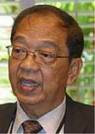
Ang Choo Hong

The current president Ang Choo Hong is expected to step down after serving as president since 2001. In the absence of other interested unseen hands, the vacancy will most probably see two old friends challenging each other to lead BMSM for the next two years.

Chee Peck kiat

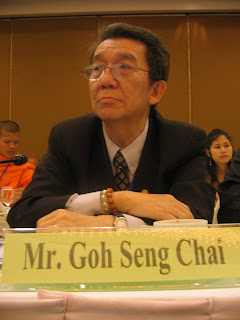
Chee Peck Kiat who is currently the Secretary General will be one of the candidates while Goh Seng Chai, a central committee member will be the other candidate offering themselves for the seat expected to be vacated by Ang. Chee Peck Kiat was formerly the president of the society from 1996 - 2001 while Goh Seng Chai has served as the Secretary General of the society intermittenly from 1982 and 2002.


Goh Seng Chai

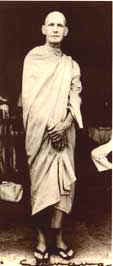
Both candidates who are in their sixties are not new to the Buddhist community and has been involved in Buddhist organisational activities since early 1960s. Co-incidentally both began to be linked to Buddhist activities during their youth days in Kuala Terengganu during the early days of Buddhist youth activism under the inspiration of the late Venerable Sumangalo (Robert S. Clifton) or more affectionately known as Father Sumangalo to those who were close to him.

Ven. Sumangalo


The Terengganu Buddhist Youth Circle (TBYC) was one of the active youth circles during that period. TBYC even hosted the Federation of Malaya Buddhist Youth Fellowship convention in 1964. While Buddhist youth conferences nowadays focus on discussion and planning, the said conference in 1964 focuses on sporting events, social visits and feasts, a reflection of the youth lifestyle during that time.


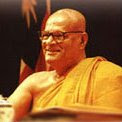
Ven Dhammananda

BMSM was form in 1962 by the late Ven Dr Kirinde Sri Dhammananda Nayaka Maha Thera or fondly known as "Chief" to his devotees and the Buddhist circles. One of the main objectives of the society is to encourage the study and propagation of Buddhism. Since its inception, to achieve its stated objectives, two of its main activities were conducting religious talks and publication of booklets and books in Buddhism for free distribution and sale.


Ven Dhammananda played the pivotal role in developing BMSM to a respectable and influential Buddhist organisation. He was a prolific writer and most if not all of the local titles in BMSM publication list were written by him. He gave Dhamma lectures practically in very nooks and corners of Malaysia.


No village is too rural or too far for him to travel, no crowd is too small or too young for him to address. He speaks the Dhamma to all. He speaks gently but firmly with compassion and wisdom. He carries the message of the Buddha and also BMSM's logo everywhere he goes since his publication is widely distributed. The late Chief is endeared by many and a Buddhist icon to many all over the world.


Ven Dhammananda gained his freedom from this world on 31 August 2006 and bequeated his wisdom and knowledge to the people through the millions of publications spread all over the world in multi languages. With his passing, BMSM also lost its Spiritual Director and General Advisor who always touch base with the developments and functions of the society.


After three years of his demised, it is time to review to gauge if BMSM still moving progressively based on the solid foundation laid by Ven Dhammananda or the society is now slowing down and began to live on past glories, surviving on the late Venerable's publication by repackaging its cover without releasing any new and comparable publication.


Within the BMSM circle, other than the limited number of lay persons who still vigorously contributes their time and efforts in delivering Dhamma talks especially in the English language in the name of BMSM, clearly there is no one in the robes that comes close to the late Venerable's stature in propagating Buddhism to the masses and plays the pivotal role in providing spiritual leadership to its members.


Most of the time we only realised our loss and began to grief when a person left and no more with us in this world. That is the reason we need to show our appreciation and gratitude when the person is still with us. It is due to this reason that in 2002 three individuals took the initiative to mobilised the Buddhist community all over Malaysia to confer the Lifetime Achievement Award to Ven. Dr K. Sri Dhammananda.


The three Buddhist workers Goh Seng Chai, Sarath W. Surendre and the author, has been closely associated with the venerable for many years. In less than two months they managed to collect more than 100,000 signature and messages from Buddhist devotees in Malaysia via postcards and a specially dedicated website. The Lifetime Achievement Award from the Malaysian Buddhist community was presented to the late Venerable on 9 December 2002 in front of about 600 Buddhist leaders from 20 countries.


The man is no more physically with us but we can cherish the good memories and follow the wisdom of the great man by continuing his good work started and consolidated by him. It is in this sense that the new leadership of BMSM need to continue the great work by Ven Dhammananda. BMSM as an national organisation with good links to the government and other local and international bodies need to live up to its name as a missionary society and focus on the core duties and obligations to the Buddhist community in Malaysia.


As members of the society, it is not too much to ask the next leadership to be more focus on the study and propagation of the Buddha-Dhamma. As usual there will be different opinions but if we keep to the main life-line of the society which is missionary work, the society should be able to do well to strengthen and protect the Buddhist presence, interest and influence in this country. - Loka

Wednesday, July 29, 2009

Changing color of your blood

It is normal to hear of people changing their religious beliefs, political stand or even switching support to another football team. When to comes to race or ethnic origins, is it possible to change that?


Can a person who is born to true blue ethnic Japanese parents in Japan but now lives and works in Saudi Arabia, speaks fluent Arabic, converted to Islam after her high school and married a true blue Arab man after her graduation, morphed into an Arabic lady?


One shall not confused citizentry with the cultural lineage of her ancestors. No matter how hard she changes her appearance, improves her Arabic linguistic skills or even trying too hard to aped the locals in their way of life, the blood that flows throughout her body is still very much ethnic Japanese. No matter how hard she tries she will not be able to change that, even to the extend of behaving more than the Arabs themselves. Or even to the extend of putting in every possible effort to run down or suppress her own ethnic Japanese ancestry so that she could gain the acceptance of the Arabs.


Incidences like the fictitious Japanese lady above are not alien to many of us. During World war Two, there were many who had forsaken their own ethnic ancestry by aping the Japanese or their masters to gain favours or brownie points. These people may have a good time during the three and a half years of Japanese occupation by betraying their own community which caused deaths, undue harm and unnecessary sufferings to their friends and villagers. In the eyes of the people that they betrayed, these double faced agents are traitors and shall be destined to the 18 levels of Hell, literally.


Are these sort of people stil exists nowadays? Open our eyes and we shall see them in the guise of different shapes and colours, professions and organizations. They may be just lurking around the corner or may have studied or work in the same place as any one of us. We just need to be vigilant and cautious with their existence and not to fall into any of their manipulation. We cannot do anything to help them.


It it their own choice of trying to hard to change their ethnicity even after knowing they can't change the colour of the blood that flows within them. The harm that they might possibly cause to the community and themselves, we will leave it to karma to take its own course. - Loka